

FROM PLASTIC WASTE TO SUSTAINABLE MARBLE

OUR JOURNEY
We are Louise and Merl, Swedish sisters who have lived in the UK since we were little. We’ve always loved making things, and from a young age were taught to be resourceful, and to love and respect our environment.
Louise started experimenting with waste plastic in 2012 whilst at Brighton University, and started her studio in 2015, a year after graduating. She then spent two and a half years refining the processes and working on commissions, culminating in designing and building a large hydraulic press capable of producing sheets of recycled plastic for larger applications of the material.
Merl joined in 2017 after a huge tabletop project was undertaken, and with her also having an artistic background, as well as having worked in interiors, it couldn’t have been a better pairing. In early 2018, Weez & Merl was founded.
"Everything we have learnt over the years has been through trial and error - there’s BEEN NO rulebook to follow with what we do, and we are still learning and improving with every week that goes by."

WHY WE DO IT

A PLASTIC PROBLEM
Due to its usefulness across many industries worldwide, millions of tonnes of virgin LDPE are produced each year, and global demand for it is expected to keep growing into the 2030s.
Unfortunately most applications of plastics are for single use, or regarded as disposable, so we want to challenge throwaway culture by showing how beautiful plastic can be.
Although LDPE is encouraged to be recycled on the label, it is often difficult to find facilities that do. In the UK, huge amounts are shipped abroad to be recycled, which is an inefficient and unsustainable practice. At Weez & Merl, we intercept this undervalued material, and champion local recycling.
SUSTAINABILITY
Weez & Merl is a company designed around the circular economy concept, and offers restoration and reparation schemes for all of our products, to support this vision of a future without waste.
We can create truly sustainable products by making the most of LDPE's ability to be endlessly remelted and repurposed.
Our ultimate goal is for plastic to be regarded as a precious material, and not one worthy of ending up in landfills, incinerators and oceans.


OUR RECYCLING PROCESS
COLLECTIng & CLEANING
Low-density polyethylene (LDPE, recycling symbol 4) is commonly found in plastic bags, pallet wrap and other flexible sheet packaging.
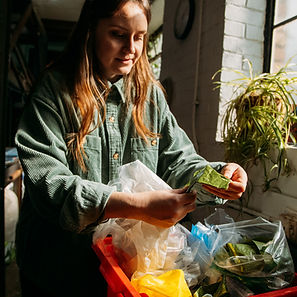
Waste LDPE plastic is collected from various local shops and businesses in Brighton & Hove; the stock they order from their suppliers arrives to them individually wrapped in this single-use packaging.
Contaminants such as paper labels, sticky tape and sealing strips are removed.


MELTING & KNEADING
The plastic melts in bundles in our ovens at around 150°C, before being kneaded by hand using heat resistant gloves. Kneading the plastic removes much of the air that was trapped during the melting process - as the plastic stretches, the air pockets expand and burst.
COLOUR MIXING
The majority of the plastic we recycle is either completely clear, or has a small amount of black or white writing. This forms the perfect base to mix in a small amount of colour, creating translucent hues.
The pigment mostly comes from other waste plastic (e.g. orange from Sainsbury's carrier bags), usually added at less that 0.5% of the total volume. Colours can be mixed like paints - we have a whole book of recipes for our colourways.
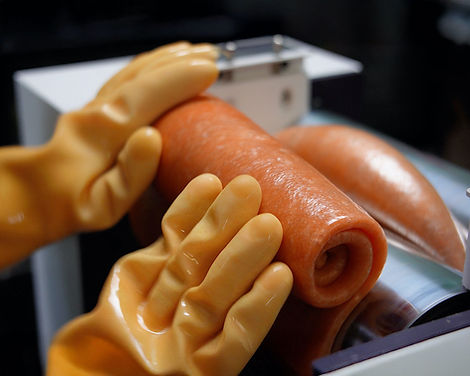
Once the pigment has been added, the plastic is passed through a heated roll mill several times to achieve a smooth consistent colour.

LAYERING
The marble effect is created by layering coloured masses of plastic with thin sheets (usually carrier bags), forming a large 'cake'.
The cake is then cut and rearranged, sometimes adding more sheets ('veins') along the way.
The veins add contrast, definition and depth by creating flowing wisps reminiscent of natural marble.
Layering the plastic in this way creates a dramatic cross-section, as seen when the cake is sliced into portions, ready for hand-marbling and pressing.
Marbling & Pressing
The portioned plastic is next marbled by hand, opening up and spreading the layers further to reveal more veins in the cross section. Each individual mass is shaped into rounds or oblongs.
The masses are pressed individually or together depending on the product being made.
For large sheets (table tops/bar tops), multiple masses are laid onto the bed of the hydraulic press in a predetermined pattern. The top bed is then lowered and pressure is applied, fusing the masses and forming one large sheet. This creates a geometric pattern, which can be either a hexagonal or square design depending on the mass formation.


CUTTING & FINISHING
LDPE can be cut and finished using most woodworking tools and machinery. In-house we use a combination of electric and hand tools to finish our pieces. LDPE can also be CNC cut, which we are able to outsource.
Large sheets are machine sawn, then routered or hand-planed depending on the desired profile. Finally the surface and/or edges are sanded to a high shine.
Vases and bottle openers are hand-shaped when melted, then carved with whittling knives, planes, and spokeshaves.
All the offcuts, shavings and dust created during these processes are remelted and repurposed into future products.
PROCESS VIDEOS


See commonly asked questions here. If you can't find the answer you're looking for, contact us and we'll help!